Medical treatments for patients are decided after seeking their consent and explaining all the consequences. Consent indicates that the patient is well aware of the seriousness of his situation and the type of treatment he will be receiving. Consent ensures that all parties know about the consequences and that nothing will come as a surprise.
A minor treatment consent form refers to the process of seeking permission regarding medical treatment for children aged below 18. Since minors are unaware of their medical situation and cannot make decisions, their parents, guardians, or a person with average medical knowledge sign off on the consent form for a minor.
All medical treatments treat ailments, but some of these treatments have severe consequences, i.e., amputation, restricted mobility, or restricted food choices. Therefore, it is compulsory to seek patients’ validation in all matters. Patients can sue medical staff if they do not seek their consent and go ahead with a certain procedure. These laws are enforced by the government to ensure the safety of its citizens.
Parts of the form
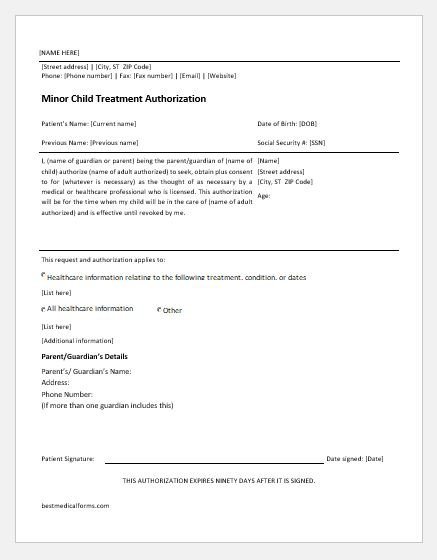
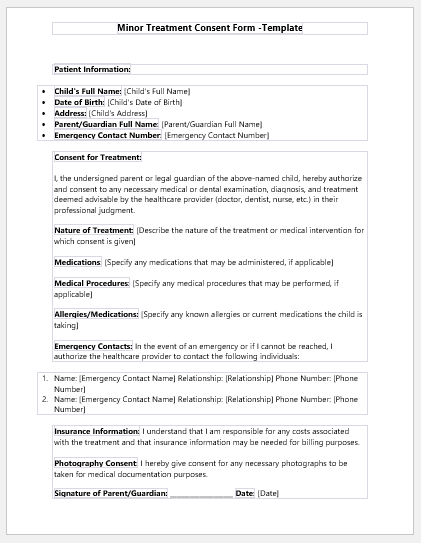
Minor treatment consent forms are pre-designed by hospital administration and are filled out by each patient undergoing major treatments. Some essential components of a consent form are given below:
- Patient’s information: The consent form includes name, age, contact information, address, and date of birth.
- Medical conditions: it briefly describes the medical condition of the minor and also adds test results to support the severity of the condition.
- Treatment plan: The complete prognosis and treatment plan, whether it includes surgery or courses of medication, are described in detail. It also shares post-surgery battles that minors have to endure. Recovery time, food, and other restrictions are all discussed in detail.
- Consent: either a guardian or parent sign the consent form of a minor. In the absence of a guardian, a person with medical knowledge usually opts to sign consent, thus making sure that everything is in the best interest of the minor.
- Consenting adults: The person signing off on the consent is known as a consenting adult, and his name, address, age, gender, and contact information are all mentioned in the consent form so that he can be easily contacted.
- Scope: consent forms are usually valid for a brief period of time and cannot be catered to after their due date. This period lasts until the discharge and after the care of the minor is done.
- Authorization: consenting adults sign consent forms and authorize healthcare professionals to go ahead with the treatment.
Benefits of using the form
Minor treatment consent forms have the following advantages:
- Medical professionals are responsible for seeking the patient’s or guardians’ consent before going forward with the treatment, thus helping the patient know all about the treatment and aftercare.
- Medical facilities are bound by law to seek consent to avoid any legal issues.
- During emergency situations, doctors are not bound to sign consent forms and start the treatment right away.
- In the absence of a guardian, a medically proficient individual signs consent by viewing the whole situation and making the health of the minor a priority.
Minor treatment consent forms are a necessity at every medical facility and protect both patients and doctors against legal issues.
Preview